
DoxyPEP vs PrEP: What Each One Does
PrEP and doxy-PEP sound alike, but they prevent different things. PrEP is HIV prevention: medicine (pills or shots) that people without HIV take to greatly reduce their chance of getting HIV. Doxy-PEP is an antibiotic, doxycycline, taken after sex to lower the chance of some bacterial STIs: syphilis, chlamydia and, in some studies, gonorrhea. Doxy-PEP does not prevent HIV, and PrEP does not prevent other STIs.
The short version: PrEP is for HIV. Doxy-PEP is for syphilis, chlamydia and gonorrhea. Some people use both, and neither one replaces regular STI and HIV testing. CDC recommends that healthcare providers talk about doxy-PEP with gay and bisexual men and transgender women who've had syphilis, chlamydia or gonorrhea in the last 12 months. Whether either one is right for you, and how to take it, is a conversation for you and your healthcare provider.
This guide explains the difference using CDC's guidance. It isn't medical advice, and it doesn't cover how to take either medicine. Your provider and pharmacist will tell you that.
PrEP vs doxy-PEP at a glance
| PrEP | Doxy-PEP | |
|---|---|---|
| What it is | HIV prevention medicine (pills or shots) | An antibiotic (doxycycline) |
| What it helps prevent | HIV | Syphilis, chlamydia and some gonorrhea |
| When it's taken | Before any exposure, as prescribed | After sex, within a time window |
| What it doesn't do | Prevent other STIs or pregnancy | Prevent HIV, herpes or other STIs |
Sources: CDC's pages on preventing HIV with PrEP and preventing STIs with doxy PEP.
What PrEP does
PrEP stands for pre-exposure prophylaxis: "pre" because it's medicine you take before a possible exposure. The CDC describes it as medicine, pills or shots, that greatly reduces your chance of getting HIV from sex or injection drug use. It's for adults and adolescents without HIV who may be exposed to HIV.
Two things CDC stresses about PrEP:
- It has to be taken as prescribed. If it isn't, there may not be enough medicine in your bloodstream to block the virus.
- It only covers HIV. CDC says PrEP reduces the chance of getting HIV but doesn't prevent other STIs or pregnancy, and that condoms can help prevent certain other STIs and pregnancy.
Before starting PrEP you take an HIV test, and while you're on it you visit your provider routinely for follow-up visits, HIV tests and refills or shots.
What doxy-PEP does
Doxy-PEP (also written doxyPEP or doxy PEP) stands for doxycycline post-exposure prophylaxis: "post" because it's taken after a possible exposure, not before. Doxycycline is a common antibiotic.
CDC explains that taking doxycycline within 72 hours after sex can help some people reduce the chances of getting syphilis, chlamydia and, in some studies, gonorrhea. CDC's consumer page says to take it "as soon as possible, within 72 hours" after sex. That's the whole timing picture this guide will give you: the amount, the number of pills and how often are for your healthcare provider to set, and CDC itself says your provider will tell you how many pills make one dose.
What doxy-PEP is not:
- Not HIV prevention. CDC is clear that doxy-PEP can only help prevent chlamydia, syphilis and gonorrhea. It does not prevent other common STIs, like HIV or herpes.
- Not a treatment. CDC notes that the antibiotic dose used in doxy-PEP is not strong enough to treat an STI if you already have one. If you test positive, your provider can get you the right medicine.
- Not the same as HIV PEP. HIV PEP is a different medicine that CDC describes as being for emergency situations after a possible HIV exposure. If you think you've been exposed to HIV, talk to a provider, an emergency room or urgent care right away.
Who each one is for, according to CDC
PrEP
CDC's PrEP page says you may be a good candidate if you don't have HIV and, for example, in the past 6 months you've had anal or vaginal sex and you have a partner with HIV, haven't consistently used a condom, or have been diagnosed with an STI. It also lists people who inject drugs and share equipment or have an injection partner with HIV, and people who've been prescribed HIV PEP and have ongoing risk or have used it more than once. CDC adds that you may choose to take PrEP even if none of those apply to you.
Doxy-PEP
CDC's recommendation is narrower. Its 2024 clinical guidelines recommend that providers counsel gay, bisexual and other men who have sex with men, and transgender women, who've had at least one bacterial STI (syphilis, chlamydia or gonorrhea) in the past 12 months about the benefits and harms of doxy-PEP, and offer it through shared decision-making. The guidelines say providers could also discuss it with people in those groups who haven't had a bacterial STI in the past year but expect activities that increase their chance of exposure.
For everyone else, the guidelines say no recommendation can be given yet. That includes cisgender women, cisgender heterosexual men, transgender men, and other queer and nonbinary people. The evidence there is limited: the only trial in cisgender women, in Kenya, found no significant reduction in bacterial STIs. CDC says providers should use their clinical judgment for people outside its recommendation, and that it will update the guidelines as more data come in.
Can you use both?
Yes. In the US DoxyPEP trial that CDC's guidelines draw on, about two-thirds of the 501 participants were already taking HIV PrEP. CDC's guidelines say doxy-PEP should be part of a broader sexual health plan that includes STI testing and treatment, vaccines, and linking people to HIV PrEP or HIV care as appropriate. And CDC's doxy-PEP page tells people without HIV that PrEP is one of their options for preventing HIV.
Neither one replaces testing
This is the part that's easy to miss. Taking a prevention medicine is a reason to test regularly, not a reason to stop.
- On doxy-PEP: CDC says to keep seeing your provider every 3 to 6 months, and that regular HIV and STI screening is important to find and treat any infections. Those visits are also when you and your provider decide whether doxy-PEP is still right for you.
- On PrEP: your follow-up visits include regular HIV tests, but CDC notes PrEP doesn't prevent other STIs, so STI testing still matters.
Our guide to how often you should get tested for STIs turns CDC's testing advice into a simple 3, 6 or 12-month schedule.
What researchers are still learning
Doxy-PEP is a relatively new strategy. CDC lists two open questions: whether it affects the "good" microbes in the gut and on the skin, and whether wider doxycycline use could make some germs harder to treat (antimicrobial resistance). That's one reason CDC's guidelines focus on the groups where doxy-PEP has been shown to work. It's also a good thing to talk through with your provider.
How to bring it up with your provider
CDC encourages an open and honest conversation with your healthcare provider about the kinds of sex you have, so you can decide together whether doxy-PEP or PrEP fits. A few pointers from CDC's doxy-PEP page:
- Expect personal questions. They help your provider understand how to keep you healthy.
- Mention every medicine you take, including over-the-counter ones, so your provider can check for interactions.
- Ask about follow-up, including how often to come back.
- There are other options if you're not comfortable talking to your regular provider: CDC notes many clinics offer confidential, free or low-cost testing and can prescribe doxycycline.
It's a routine conversation for sexual health clinics. You don't need to justify asking.
Keeping track: testing dates and reminders
Once a provider has prescribed PrEP or doxy-PEP, the practical challenge is remembering: a daily pill, a time window after sex, and a test every few months.
Hook has three free reminders for this in Settings under Sexual health. They're set up and stored on your iPhone, with no account.
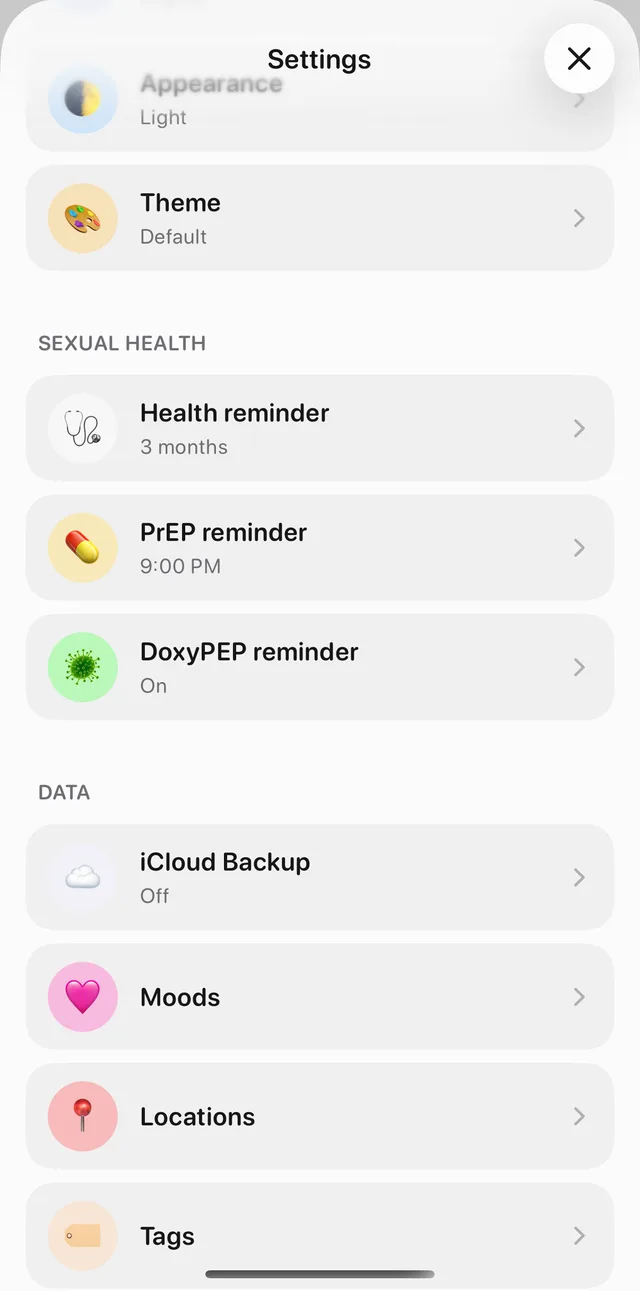
- PrEP reminder: one daily notification at a time you choose, for daily PrEP pills. Our guide to remembering to take PrEP every day covers it and other habits that help.
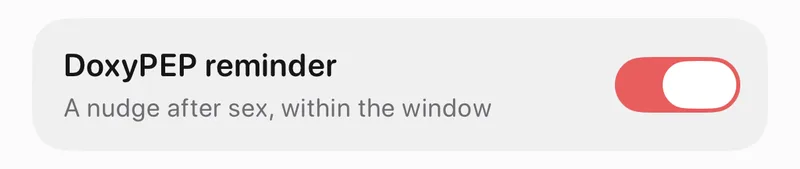
- DoxyPEP reminder: off until you turn it on. Then, when you log a new entry with a partner, Hook schedules up to two discreet nudges inside the 72-hour window CDC describes, and never more than once in 24 hours. The notification just says "Reminder" and "Time-sensitive: take your dose when you can". It only works when you log the entry, and it doesn't record whether you took anything. It's a nudge, not a dose log or medical advice.
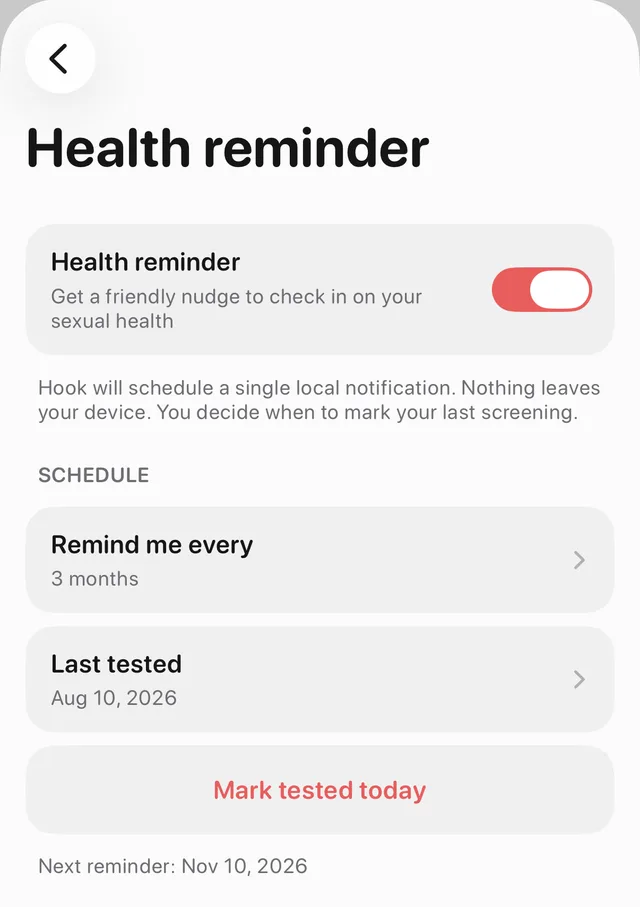
- Health reminder: a nudge to get an STI test every 3, 6 or 12 months, counted from the date you last tested.
Since both CDC pages come back to regular testing, the Health reminder is the one worth setting even if you take neither medicine.
Hook doesn't decide whether doxy-PEP or PrEP is right for you or how to take them. Your provider does; the app just helps you follow the plan you agreed on.

Hook: private intimacy journal
Log moments, moods and protection, set discreet STI test, PrEP and DoxyPEP reminders, and keep it all on your iPhone. No account needed. Face ID lock and iCloud Backup with Hook+.

FAQ
Does doxy-PEP prevent HIV?
No. CDC says doxy-PEP can only help prevent chlamydia, syphilis and gonorrhea. It does not prevent HIV or herpes. PrEP is the medicine for HIV prevention.
Does PrEP protect against STIs?
No. CDC says PrEP reduces the chance of getting HIV but doesn't prevent other STIs or pregnancy. Condoms can help prevent certain other STIs.
Is doxy-PEP recommended for women?
Not yet. CDC's 2024 guidelines say no recommendation can be given for cisgender women, because the evidence is limited and the one trial in cisgender women didn't show a significant reduction in bacterial STIs. Providers can use their clinical judgment, so it's still worth asking. CDC says it will update the guidelines as research continues.
Is doxy-PEP the same as PEP?
No. HIV PEP is a different medicine that CDC describes as being for emergencies after a possible HIV exposure. Doxy-PEP is an antibiotic for some bacterial STIs. Both are taken after an exposure, which is where the "post" in the names comes from.
Do I still need to get tested if I take doxy-PEP or PrEP?
Yes. CDC says people on doxy-PEP should keep seeing their provider every 3 to 6 months for HIV and STI screening, and PrEP includes regular HIV tests. See our STI testing schedule for how often.