
How Often Should You Get Tested for STIs? A Simple Schedule
Most sexually transmitted infections don't announce themselves. The CDC puts it plainly: STIs often have no symptoms, so you may not know you have one. The NHS says the same, and adds that the only way to know for sure is to get tested. So "how often should I get tested?" is a good question, and the honest answer depends on your situation.
The short version: everyone aged 13 to 64 should be tested for HIV at least once. Many sexually active people should be tested at least once a year (see the table below for who), and gay and bisexual men with multiple or anonymous partners every 3 to 6 months. Get tested with every new partner, and any time you have symptoms or a partner tells you they have an STI. Your clinician can tailor this to you.
This guide sums up what the CDC (US) and NHS (UK) recommend, then turns it into a schedule you can set and forget. It isn't medical advice; a doctor, nurse or sexual health clinic can tell you exactly which tests you need.
How often to get tested, by situation
These are the CDC's recommendations from its pages on getting tested for STIs and getting tested for HIV.
| Your situation | What the CDC recommends |
|---|---|
| Everyone aged 13 to 64 | An HIV test at least once |
| Sexually active women under 25 | Chlamydia and gonorrhea tests every year |
| Women 25 and older with a new partner, multiple partners, or a partner who has an STI | Chlamydia and gonorrhea tests every year |
| Sexually active gay and bisexual men, and other men who have sex with men | Syphilis, chlamydia, gonorrhea and HIV at least once a year; every 3 to 6 months with multiple or anonymous partners |
| More than one partner since your last HIV test, or a partner whose sexual history you don't know | An HIV test at least once a year |
| Diagnosed with or treated for another STI | An HIV test at least once a year |
| Anyone who shares injection equipment | An HIV test at least once a year |
| Pregnant | Syphilis, HIV, hepatitis B and hepatitis C early in pregnancy |
| Most sexually active adults | Syphilis testing based on where you live (ask your provider) |
If you've had oral or anal sex, the CDC suggests asking your provider about throat and rectal testing.
When to get tested outside your routine
A yearly or quarterly check is the baseline. Some moments call for a test sooner. The NHS says to go to a sexual health clinic if:
- you think you may have an STI
- a sexual partner has symptoms of an STI
- you're worried after having sex without a condom or dental dam
- you're pregnant and have symptoms of an STI
- you're having sex with new partners
If you have symptoms, don't wait for your next scheduled test. Go now.
How long to wait after a possible exposure
Tests can't pick up an infection the moment it happens. The NHS says STIs can take up to 7 weeks after unprotected sex to show up on a test, so if you don't have symptoms, it's best to wait 7 weeks before getting tested.
The NHS advises not having sex, including oral sex, without a condom or dental dam until you've had a check-up or been tested.
What about if you're in a relationship?
The guidelines are based on risk, not on relationship status. If you and a partner have both been tested since you got together and neither of you has other partners, the routine checks in the table still apply (for example, the yearly chlamydia and gonorrhea test for women under 25). If either of you has other partners, or you're not sure, test on the schedule that fits the person with the most partners. It's a normal conversation to have, and testing together can make it easier.
If you take PrEP
PrEP comes with its own testing rhythm. The CDC's PrEP page says you must take an HIV test before starting, and while you're on PrEP you'll visit your provider routinely, as recommended, for follow-up visits, HIV tests and prescription refills. Follow the testing schedule your prescriber gives you.
Pick a schedule you'll actually keep
It's easy to mean to get tested and then lose track of when you last went. The simple fix is to choose a cadence once and let a reminder do the remembering:
- Every 12 months if your situation matches the "at least once a year" rows above.
- Every 6 months if you're somewhere in between, for example dating and meeting new partners now and then.
- Every 3 months if you have multiple or anonymous partners, which matches the CDC's 3 to 6 month range for higher-risk situations.
Count from the date of your last test, not from New Year's Day, and reset the clock each time you test. Then add a test whenever one of the "outside your routine" moments happens.
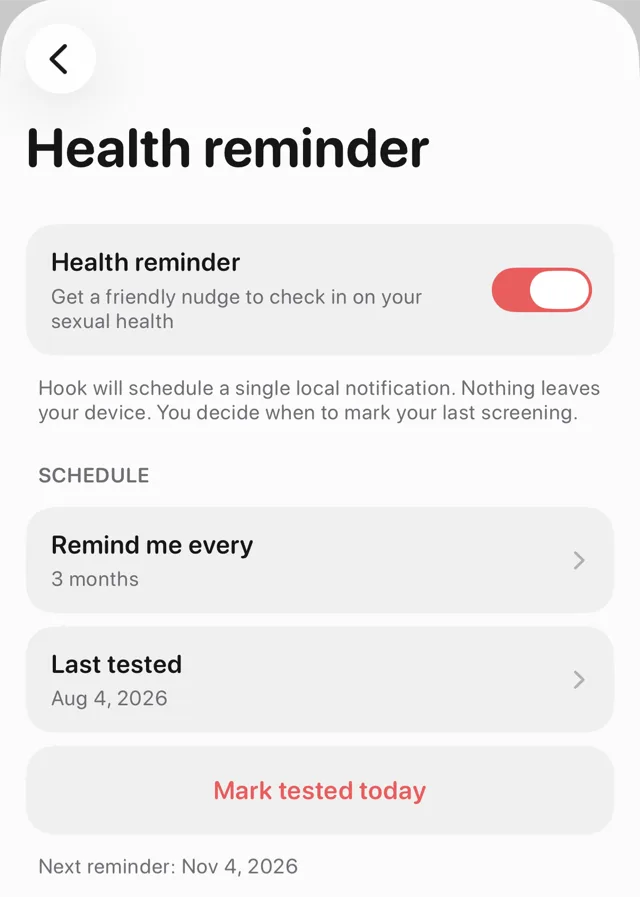
If you use Hook, its Health reminder does exactly this. You pick every 3, 6 or 12 months, set when you were last tested, and tap "Mark tested today" after each test to restart the countdown. It's a single local notification on your iPhone, and nothing leaves your device. The reminder is free.
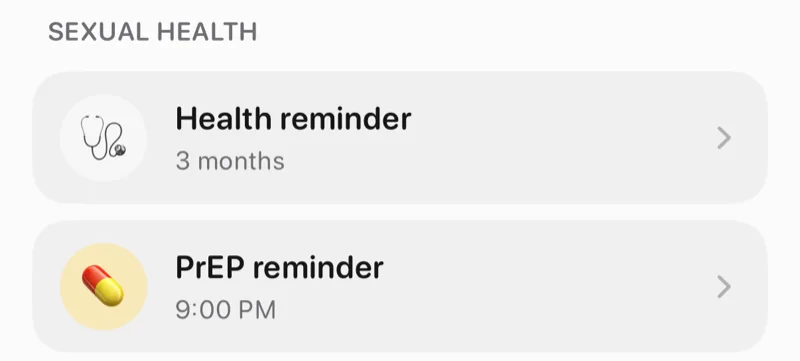
Hook also has optional PrEP and DoxyPEP reminders in the same Sexual Health section of Settings, for people whose clinician has prescribed them.
Where to get tested
In the US, the CDC lists three options:
- A healthcare provider's office or clinic, even if you have no symptoms. Confidential free or low-cost clinics are available, and GetTested can help you find one near you.
- At-home self-tests, using a swab or finger-prick, with results in minutes for some infections.
- Self-collection kits that you mail to a lab, with results in a few days.
In the UK, sexual health clinics test for and treat STIs for free. The NHS says you don't usually need a GP referral or an appointment (contact the clinic first to check), you don't have to give your real name, and nothing about your visit is shared with your GP unless you ask. Some clinics also offer home testing kits. You can find a sexual health clinic on the NHS website.

Hook: private intimacy journal
Log moments, moods and protection, set discreet STI test, PrEP and DoxyPEP reminders, and keep it all on your iPhone. No account needed. Face ID lock and iCloud Backup with Hook+.

FAQ
How often should you get tested for STIs if you're sexually active?
At least once a year is a sensible baseline for most sexually active adults, and it's what the CDC recommends for several groups, including women under 25 and gay and bisexual men. Every 3 to 6 months is recommended if you have multiple or anonymous partners. Everyone aged 13 to 64 should have at least one HIV test.
Should I get tested after every new partner?
Testing when you start having sex with a new partner is a good habit, and the NHS lists having sex with new partners as a reason to visit a sexual health clinic.
How soon after sex can I get tested?
It depends on the infection. The NHS says STIs can take up to 7 weeks to show up on a test, so if you have no symptoms it's best to wait 7 weeks. If you have symptoms, get checked straight away.
Can I have an STI without symptoms?
Yes. Both the CDC and the NHS say many STIs have no symptoms, which is exactly why regular testing matters.